
 By IndiaHub
This ruling was made in the context of a maintenance case under Section 125 Code of Criminal Procedure (CrPC), filed by a wife. On August 20, 2025, the family court ruled in favour of the wife and ordered the husband to pay her Rs 2,500 per month. He challenged this order in the high court and lost.
In her court application, the wife mentioned that they got married on November 28, 2013 in Jalandhar, Punjab. However, she claimed that soon her husband and in-laws began to harass her for dowry. She alleged that on February 2, 2021, her sister-in-law and other family members assaulted, calling her ““मनहूस.” (Manhus meaning unlucky or a jinx).
After this February 2 incident, she claimed that her husband left her in a rented accommodation for 20 days before her brother brought her back to Lucknow, Uttar Pradesh, on February 21, 2021. In court, she claimed that she had no source of income to support herself while her husband was earning around Rs 60,000 per month from fruit business as well as Rs 40,000 from rental properties. Therefore, she asked for Rs 50,000 per month as interim maintenance.
The family court in its order noted that neither the husband nor the wife submitted any documentary evidence regarding their respective incomes and so the court said that it has to rely on a reasonable estimation.
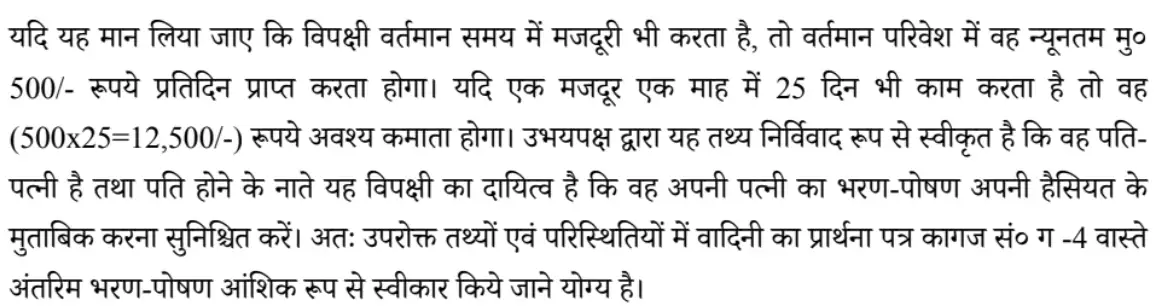
The family court said that since the husband is capable of working, it was assumed that if he took a job as a labourer, he would earn at least the minimum wage. Thus the court calculated:
“If a labourer works for 25 days in a month, he surely earns (500*25=Rs 12,500” Based on this assessment, the family court ordered the husband to pay Rs 2,500 per month to the wife from the date of the application.
The Family court order dated August 25, 2025, said (an extract):
Against this family court order, the husband filed an appeal in the Allahabad High Court but lost the case on November 24, 2025.
Alay Razvi, Managing Partner, Accord Juris, said to ET Wealth Online: The Allahabad High Court confirmed that the husband must pay Rs 2,500 per month as interim maintenance to his wife. The wife had no income of her own, and the Family Court had already found this amount reasonable.
Razvi says that the husband tried to avoid paying by saying he was unemployed. However, the High Court made it clear that an able-bodied man cannot escape his legal responsibility to support his wife by simply claiming he has no job.
Razvi says: “The law expects a husband to make basic efforts to earn, even through simple labour if needed, so that his wife is not left without essentials. The Court also noted that the amount ordered was very small and the husband had shown no proof that he was truly incapable of earning.”
According to Razvi, since maintenance is meant to prevent a deserted spouse from suffering financially, the Court found the Family Court’s order fair and refused to interfere. The husband’s challenge was dismissed.
Naman Singh Bagga, Partner, C&S Partners, says that this judgment reiterates that Section 125 CrPC is intended to secure maintenance for a wife without independent means, effective from the date of her application.
According to Bagga, the Court relied on Supreme Court precedents, including the recent decision of “Rina Kumari v. Dinesh Kumar Mahto” wherein the Supreme Court observed that the maintenance amount should ordinarily be fixed at 25% of the net income of an able-bodied husband in a situation wherein financial capacity of the husband is not proved.
Bagga says: “In this case, since the wife could not prove the husband’s income, the Court applied minimum wage standards to determine the quantum, ensuring fairness and adherence to the protective purpose of the provision.”
Allahabad High Court analysis of facts
The Allahabad High Court said that before entering into the facts of the case, it would be apt to refer to the observations made by the Supreme Court in relation to dealing with the applications under Section 125 Cr.P.C.
The Supreme Court in the case of Anju Garg and another vs. Deepak Kumar Garg, reported in 2022 SCC OnLine SC 1314, observed as under:-
“9. At the outset, it may be noted that Section 125 of Cr.P.C. was conceived to ameliorate the agony, anguish and financial suffering of a woman who is required to leave the matrimonial home, so that some suitable arrangements could be made to enable her to sustain herself and the children, as observed by this Court in Bhuwan Mohan Singh v. Meena (2015) 6 SCC 353. This Court in the said case, after referring to the earlier decisions, has reiterated the principle of law as to how the proceedings under Section 125 Cr.P.C have to be dealt with by the Court…
The Allahabad High Court cited multiple court judgements and said that they have also considered the observations made by the Supreme Court in the case of Rina Kumari v. Dinesh Kumar Mahto, (2025) 3 SCC 33.
The Supreme Court in Kulbhushan Kumar Vs. Raj Kumari, (1970) 3 SCC 129 case has held that 25% of the husband’s net salary would be just and proper to be awarded as maintenance allowance to the wife. The amount of permanent alimony awarded to the wife must be befitting the status of the parties and the financial capacity of the husband to make the payment.
Allahabad High Court judgement
The Allahabad High Court said that in the Kalyan Dey Chaudhary Vs. Rita Dey Chaudhary Nee Nandy, (2017) 14 SCC 200 judgement, the Supreme Court has followed the quantum of maintenance fixed by the Supreme Court judgement in Kulbhushan Kumar that held that 25% of net income of the husband should be paid to the wife as maintenance.
Allahabad High Court said: “Considered the aforesaid including the judgments, referred above, and the amount awarded by the Family Court i.e. Rs 2,500 per month to the opposite party No. 2 (wife) after recording sufficient reasons in this regard in the impugned order dated August 20, 2025 regarding financial status of the revisionist.”
Judgement:
- Upon due consideration of the aforesaid, this Court finds no illegality, irregularity, or jurisdictional error in the order impugned dated 20.08.2025 for the reason that a meagre amount i.e. Rs 2500/- per month has been awarded by the Family Court to the opposite party No. 2 (wife)towards the amount of maintenance.
- The instant revision is accordingly dismissed. No order as to costs.
- The copy of the order be sent to the Court concerned forthwith.
Kritika Seth, Founding Partner, The Victoriam Legalis, says that in the instant matter, the Hon’ble High Court referred various precedents including the Hon’ble Supreme Court’s judgement in the case of Anju Garg and Anr. v. Deepka Kumar Garg and the Delhi High Court’s ruling in the case of Chander Parkash Bodh Raj v. Shila Rani Prakash, to delve into the aims, objectives and legislative intent of Section 125 of the Cr.P.C.
Seth says that from a perusal of the precedents, the judicial position that came to fore is that an able-bodied young man has to be presumed to be capable to reasonably maintain his wife and child. The husband is required to earn money even by physical labour, if he is able-bodied, and could not avoid his obligation, except on the legally permissible grounds.
Seth says: “It is a basic canon of law that it is the sacrosanct duty of the husband to provide financial support to the wife and to the minor children.The object of maintenance proceedings is not to punish a person for his past neglect, but to prevent vagrancy and destitution of a deserted wife, by providing her food, clothing, and shelter by a speedy remedy. In view of the above legal and factual matrix, the said revision filed by the husband was dismissed by the Hon’ble High Court.”