
 By IndiaHub
Lawyers representing a group of homebuyers brought to the attention of the court that there is an erroneous presumption that larger apartments are occupied by more number of people which is unconnected with the common maintenance amount. They argued that the charges for using the common areas of the apartments should be equal.
The lawyers said: “On merits of the matter he (they) would submit that as per the audit reports, common maintenance collected by the condominium is used for maintenance of common areas and amenities like swimming pool, club house, gym, park, security, etc. which are used in common by all apartment holders irrespective of their undivided share or area of their apartment.
The lawyers cited the law laid down by the Bombay High Court in the case of Venus Co-operative Housing Society Vs. Dr. JY Detwani. In that case, the Court held that common amenities are enjoyed by all members of the society irrespective of the area of flat they hold and therefore large flat holders cannot be forced to pay more maintenance towards the common facilities.
However, the Bombay High Court disagreed with this perspective. The High Court said that the argument that owners of larger apartments do not receive any additional benefit or priority in the undivided share is not valid.
An extract of the Judgement read as follows: “…in view of the applicability of the provisions of Section 10 of the Apartment Act which clearly mentions that the common profits of the property shall be distributed among and the common expenses shall be charged to the apartment owners according to percentage of the undivided interest (size of apartment) in the common areas and facilities squarely applies to the case of the Petitioners before me.”
Read below to understand what the Maharashtra Apartment Ownership Act, 1970 says about maintenance charges for using common areas of an housing project along with the legal basis for this ruling.
How did this case start?
According to Bombay High Court order dated August 4, 2025, here’s a timeline of events:
July 29, 2011: A Deed of Declaration was executed and registered subjecting the house property to the provisions of the Apartment Act.
May 31, 2017: A supplementary Deed of Declaration was executed and registered for additional construction. Deed of Apartment was executed in consonance with the Deed of Declaration with each apartment owner.
November 11, 2020: Five homeowners who had bigger apartments filed a complaint with the Deputy Registrar of Co-operative Societies alleging that the maintenance charges levied by the housing society are in violation of Section 10 of the Apartment Act.
December 28, 2020: The Deputy Registrar of Co-operative Societies issued a notice to the Chairman and Secretary of the housing society who filed their reply on December 28, 2020.
July 8, 2021: The Deputy Registrar of Cooperative Societies passed an order directing the housing society to levy maintenance charges proportionate to the undivided share (as per the size of the respective apartments) of the apartment owners in terms of Section 10 of the Apartment Act.
July 14, 2021: The housing society put a notice whereby the said changes in maintenance amount to be paid which is now to be based on the size of the respective apartments were intimated to the homeowners.
2021: A group of homeowners approached the Co-operative Court, Pune to challenge the said order dated July 8, 2021.
May 13, 2022: The Co-operative Court, Pune rejected the appeal and thus the homeowners filed an appeal in Bombay High Court.
August 4, 2025: Homebuyers lost the case in Bombay High Court.
What did the Bombay High Court say?
Justice Milind N. Jadhav of Bombay High Court said:
Resolution passed by housing society cannot override the law
- “It is seen from the record that occupants of smaller flats had therefore approached the Deputy Registrar to levy charge of maintenance as per Section 10 of the Apartment Act. Thus the Deputy Registrar considered the said issues which were also equally considered by the Appellate Court while deciding the lis between the parties.”
- “The Definition of common areas under Section 3(f), common expenses under Section 3(g) and common profits under Section 3(h) of the Apartment Act applied to the present case.”
- “It is seen that just because the association of Members in the condominium (housing society) have in the past passed a resolution for equal maintenance, it does not mean that they / or the members are estopped (can be stopped) from following due process of law. The condominium (housing society) under the Apartment Act is empowered to act in the interest of all apartment owners for maintenance of the common areas and facilities in view of Section 10 of the Apartment Act.”
Section 10 says common expenses to be charged as per size of apartment
Justice Milind N. Jadhav of Bombay High Court said:
- “The argument of the Petitioners that the Petitioners holding larger apartments do not get any additional benefit or priority of preference in the undivided share or do not have any additional benefit cannot be countenanced in view of the aforesaid observations and findings and is stated to be rejected.”
- “Thus in view of the applicability of the provisions of Section 10 of the Apartment Act which clearly mentions that the common profits of the property shall be distributed among and the common expenses shall be charged to the apartment owners according to percentage of the undivided interest in the common areas and facilities squarely applies to the case of the Petitioners before me.”
Large apartment owners cannot obstruct the implementation of beneficial law
Justice Milind N. Jadhav of Bombay High Court said (extract):
- “…The Petitioners (a select group of homeowners) have already benefited in the past due to the inequality and non-application of the statutory provisions under the Apartment Act. They cannot obstruct implementation of the provisions of the Apartment Act which squarely and admittedly applies to their case. If Petitioners’ (a select group of homeowners) case is to be accepted then the registered Deed of Declaration would be a nullity in law.
- “There is a clear distinction between the Maharashtra Ownership Flats (Regulation of the Promotion of Construction, Sale Management and Transfer) Act, 1963 and the Maharashtra Apartment Ownership Act, 1970 and rights of members under the aforesaid two statutes as applicable for levy of maintenance charges.”
Judgement: “In view of the above observations and findings, twin judgment and order dated 08.07.2021 passed by the Deputy Registrar, Co-operative Society, Pune and 13.05.2022 passed by the learned Appellate Court are upheld and confirmed. Resultantly Petition fails.”
Legal reasonings applied by Bombay High Court to reach this judgement
Justice Milind N. Jadhav of Bombay High Court said:
Deed of declaration read with Section 6(1)
- “From a conjoint reading of the aforesaid covenant in the Deed of Declaration and the statutory provisions, it is prima facie seen that the Deed of Declaration provides income and common expenses based on the side of their respective purchased apartment.”
- “Section 6(1) of the Apartment Act prima facie provides for a basis and computation of interest in the common areas and facilities of each apartment owner and it categorically states that each apartment owner shall be entitled to an interest in the common area and facilities for the percentage expressed in the Declaration (emphasis supplied).”
Justice Milind N. Jadhav of Bombay High Court said:
- “Thus it also states that such percentage shall be computed by taking as a basis of the value of the apartment in relation to the value of the total property. Section 6 of the Apartment Act further categorically provides that the percentage of undivided interest of each apartment owner in the common area and facilities as expressed in the Declaration (which is the Deed of Declaration herein) shall have a permanent character and the percentage of common undivided interest in the common area and facilities shall not be separated from the apartment to which it appertains.”
- “Thereafter Section 10 prima facie when read provides for common profits of the properties to be distributed amongst and the common expenses to be charged to the apartment owners according to the percentage of the undivided interest in the common area and facilities.”
- “Thus combined reading of the aforesaid provisions and the covenant in the Deed of Declaration which forms the basis of the MAO Agreement (Maharashtra Apartment Owner Act) each apartment owner, makes it clear that the undivided interest in the common area and facilities is an interest which runs with the apartment and upon transfer, the undivided interest, sale and transfer together with the apartment irrespective of a specific covenant to that effect in the Conveyance Deed.”
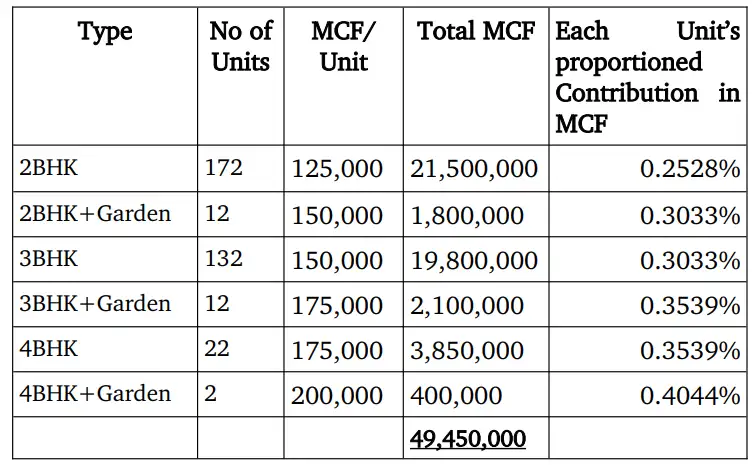
Table showing the Maintenance Corpus Fund (MCF) contribution to the total MCF collected from all Apartment owner/s by the promoter:
Bombay High Court
Deed of Declaration is made as per the Apartment Act so equal maintenance can’t happen
Justice Milind N. Jadhav of Bombay High Court said:
- “In that view of the matter, the ascertainment of percentage of interest in the common area granted to each apartment owner is according to the Deed of Declaration which is required to be calculated in proportion to the value of the apartment in relation to the value of the entire property as provided in the Apartment Act.”
- “The Deed of Declaration is found in consonance with the provisions of the Apartment Act which also affords voting rights to each apartment owner on the proportionate area of each unit to the total area of all units. Thus members holding higher proportionate value and size (area) of the apartment must contribute to the common area maintenance charges proportionately.”
Deed of declaration can only be altered by way of another registered deed
Justice Milind N. Jadhav of Bombay High Court said:
- “It is seen that in the Annual General Meeting of the condominium held on 31.07.2022 pursuant to the order passed by the learned Co-operative Court, the condominium has issued maintenance bills on the basis of the percentage share of each apartment owner with respect to the common area and facilities thereby giving effect to the impugned order.”
- “The Deed of Declaration being a registered instrument needs to be followed in view of the statutory provisions of the Apartment Act applicable to the condominium apartment purchasers. What is stated in the Deed of Declaration if not agreeable to the Members of the condominium can only be altered and modified by way of another registered instrument.”